Background
Since 1956 when Riker first developed the pressurised metered dose inhaler (pMDI) to facilitate ease of patient use over Nebulisers there has been a myriad of Inhaler types designed, developed and many commercialised.
These range from further iterations of the pMDI through early dry powder inhalers (DPI’s) that were capsule based, more elaborate yet relatively simple blister systems to reservoir and Multi Dose Powder Inhaler systems (MDPI) that proliferate the market today.
Alongside these development pathways also came breath actuated pMDI’s, so called active DPI’s, through to soft mist inhalers (SMI’s) delivered via mouth or nose to the Pulmonary route.
The range is quite extensive and so often development is accompanied by a fanfare of claims of superiority especially in terms of device resistance, which, it is always stated, is of the utmost benefit to the patient.
These claims can be misleading not least because they are often wholly device oriented using CFD and other physical characteristics, but they often overlook the most important factor – Patient Handling and Perception.
Device Resistance to Air Flow in DPI’s – Discussion
There are so many myths associated with airflow through a device, especially for DPI’s where the powder is there waiting for the patient to provide the aerosolisation themselves.
There is a commonly held belief that low resistance through a device is beneficial for the patient and high resistance gives poor performance.
However, in terms of in vitro results through FDA approved analytical tools such as an Andersen Cascade Impactor (ACI) or Next Generation Impactor (NGI) the total reverse is true.
High resistance devices require less inspiratory input from the patient to optimise aerosolisation of the powder.
With Low resistance devices the complete opposite is the case with the patient having to deliver a fast, strong inhalation to optimise aerosolisation of the powder.
This begs the question, “so why aren’t all DPI’s high resistance?” or “Why is there such a range of air flow resistance parameters across successfully marketed devices?”
As explained right at the top of the piece there is the rather obvious issue that the device needs to be convenient for the patient to use and their perception is reality despite what the physicists, who have measured the air flow from all angles and all available pathways, might suggest.
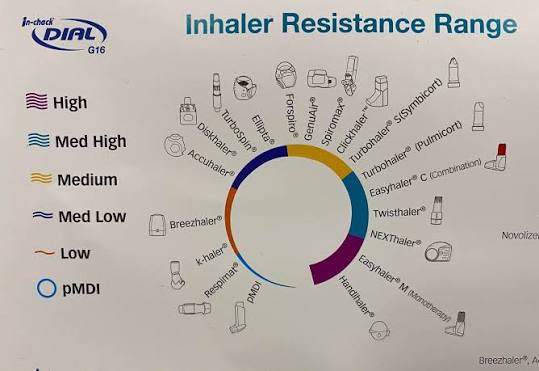
Figure 1 shows a graphic of the range of many commercially available devices in terms of their relative resistance.
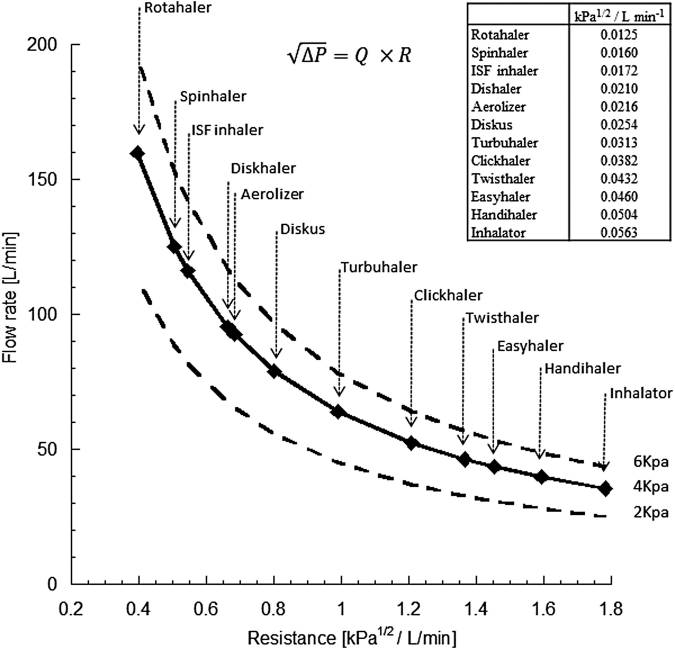
To put some real numbers in terms of air flow resistance Figure 2 contains most of the DPI’s represented in Figure 1 measuring air flow in kPa½/L min⁻¹ at pressure drops of 2, 4 and 6 kPa respectively.
The lowest resistance devices are of course the pMDI’s, SMI’s and active DPI’s where the patient is not having to make any inspiratory effort.
If we pick three of the biggest selling products as an example it becomes very apparent that there is a very broad range of air flow resistance used commercially.
The Diskus, Turbuhaler and Handihaler have all been extremely successful even though the Diskus (Advair) could be classified as medium low resistance, the Turbuhaler (Symbicort) as medium resistance and the Handihaler (Tiotropium) as high resistance.
There are several reasons for this including patient handling and perception, but this is combined with formulation (API and excipient selection) optimisation to deliver the amount of API of required efficacy to the patient.
Patients seem to prefer the apparent ease of use of low resistance devices even though they need to provide greater inspiratory flow to effectively aerosolise the powder. The converse is true with high resistance devices because the patient struggles to overcome that initial resistance even though the in vitro results show extremely good fine particle mass (FPM) in an NGI or similar. Patients for low or high resistance devices may well need extra guidance in how to maximise the effectiveness of dose delivery.
Those devices in the middle of the resistance range are likely to be the most all-encompassing in that the patient feels comfortable with the amount of inspiratory effort required and the in-vitro performance is more than satisfactory.
The Mirai™ next generation Capsule Inhaler sits right in this middle ground alongside Diskus and Ellipta devices and just below Turbuhaler in terms of resistance.
However, the overriding factor is that at the outset of development a device should almost never be selected in terms of device resistance alone.
Factors such as formulation, treatment regimen, patient handling, drug efficacy and ease of use should be considered in combination with the device resistance to air flow.
Devices such as pMDI’s deliver exceptional in-vitro performance in terms of fine particle mass deposited in the critical regions of the lung but patients can find the co-ordination of inhalation whilst depressing the inhaler difficult or struggle to depress the inhaler at all in elderly or arthritic patients.
Active DPI’s have come and gone and showing a slight rise in interest again but in reality, they are only addressing an issue that exists for very few patients.
Soft Mist Inhalers also remove the reliance on patient input and co-ordination, but they are limited in terms of the dose that can be delivered in one actuation.
Conclusion
Although device resistance to air flow is a very important consideration in the selection of a device it is only one parameter that should not be considered in isolation.
A good understanding of formulation based on drug efficacy and powder physical properties using modern particle size manipulation techniques and patient handling preferences are just as important considerations.